Long Shot

Writers: Liz Hannah & Dan Sterling 

Director: Jonathan Levine 

Long Shot is a film that switches from feeling like an idiosyncratic rom-com to plodding one – often from scene to scene. While it contains some interesting satire about U.S. political discourse and the representation of female politicians in the media, which makes it distinctive from many rom-coms, its rudimentary plotting leaves it feeling rather tame.  

The film concerns Charlotte Field (Charlize Theron) a Secretary of State about to begin a world tour before announcing a run for the Presidency. Her love interest is Fred Flarsky (Seth Rogen) a stoner journalist, who quits his job at a newspaper after it’s bought by a Fox News-like company and is hired by Field as a speech writer. They knew it each from childhood and their relationship follows the usual, somewhat tedious path of the rom-com: embarrassing first meeting creates intimacy, the schluby dude teaches the pristine woman some kind of ‘truth’ that forces her to perceive him differently, a kiss after something intense happens, a break-up followed by ‘I Love You’ less than 24 hours later.  

Both Theron and Rogan are good in their respective roles, although are they are playing very much to type. June Diane Raphael is excellent as Field’s Chief of Staff Maggie Millikin, a character with cleverness and a caustic wit. Bob Odenkirk is great as a TV star turned President, who delivers perhaps the film’s funniest line, ‘No, I will not nuke a tsunami.’ Where the film struggles is when writers Liz Hannah and Dan Sterling get confused as to what constitutes radical in a rom-com context. The brilliant and often hilarious satire of the sexualisation of female politicians in the media is radical, watching a relatively straight politician taking MDMA isn’t. It’s a scene and idea we have seen played a 1000 times. And that is where the film falters, when it struggles to raise itself from the clichés of cinematic comedy; whether it be drug taking or falling out of windows or an unfortunate masturbation experience.  

Long Shot is a somewhat interesting but mostly unremarkable rom-com. It is no sense a bad film, but the beats of the story have been written for decades, and that is the film’s central fault; what could have been a radical, genre-bending film instead feels sweet but inconsequential.  

7/10 

Tolkien

Writer: David Gleeson & Stephen Beresford.  

Director: Dome Karukoski 

Critics have to walk along the thin, often spiked tightrope between subjective and objective judgements. Whether you like or dislike a film is subjective, but you try your best to use objective reasoning as to why that is. While watching Tolkien, I saw more than a few things wrong with it; cliched score, monotone direction, by-numbers plotting, which on any other day may have made me hate it. But on this day, I just watched and smiled at a sweet film about a sweet man falling in love with a sweet girl. 

Tolkien, as you would expect, follows the early life of J.R.R. Tolkien (Nicholas Hoult) who would go onto write The Lord of the Rings, told mainly from his perspective of him thinking over his life in the trenches during the Battle of the Somme. Ronald, as Tolkien is known in the film, is raised as an orphan in a pre-war England presented with lush, saturated colours by director Dome Karukoski. After moving to Birmingham to live in an orphan boarding house, Tolkien attends a private school, where he forms the T.C.B.S. literary society with his friends Robert, Christopher and Geoffrey. There’s is a life of privilege, but one ultimately weighed down by the iron-clad fist of upper-class British social rules. Also at the boarding house is Edith Bratt (Lilly Collins), a fellow orphan and keen piano player. Her character is under-developed, and we learn little about her life previous to meeting Tolkien, but Collins is excellent at portraying her rage at the gendered codification of her existence, which falls well short of dreams of being a great pianist rather than a wife.  

Hoult and Collins are good in their respective roles and bring a real sense of warmth to the romantic arc of their characters. The film is also excellent in showing the insane levels of reservation people had to show during budding romances, the tightness of the corsets and waistcoats reflecting the social mores of the time. The film struggles by virtue of its cumbersome plot, which moves slowly and predictably – with the narrative framing of Tolkien in the trenches looking back never quite working, as there seems to be no link between him in battle and the past memory the film switches to. The scenes of trench warfare, while nicely executed, seem rather timid and hollow compared to Peter Jackson’s WWI documentary They Shall Not Grow Old, which I think at some level has destroyed the WWI biopic, as nothing could ever compare to seeing the real thing in brutal wide-screen colour.  

Tolkien has received rather negative reviews and I can understand why – it’s often understated to the point of non-existence and does the usual bad biopic mistake of forcing the main character to say something that defines their later life, in this case having Tolkien say the word ‘fellowship’ during a self-important close-up. But I just found it charming, I liked the two main characters and the whole film was obviously made with great deal of warmth for Tolkien’s life. When Tolkien leaves for France and war, Edith says to him ‘stay alive and come back to me!’ It could be cliched and cloying, the sort of line to raise to bile to throat but it just made me break out in a big grin.  

7/10 

Fight Club

Writer: Jim Uhls 

Director: David Fincher 

Released at the fag-end of the 20th Century to critical indifference and a box office mauling worthy of the film itself, Fight Club has since gone onto achieve pre-eminence in the film canon and was even proclaimed the 10th best film of all time by Empire in 2011. Its hyper-violent, nihilistic critique of modern consumer culture seems more relevant by the second. And its portrayal of masculinity, while in some sense problematic, pre-figured much of the modern-day discussions about the notion of toxicity and fragile male-ego.  

Directed by David Fincher and adapted by Jim Uhls from the 1996 novel by Chuck Palahniuk, Fight Club is the story of the unnamed narrator’s (Edward Norton) journey from office-bound lackey to God-like cult leader. He begins the film as a white-collar smudge, a nothing person who spends their time slavishly buying the entire Ikea catalogue. As Norton walks through his apartment it ingeniously becomes a catalogue, prices and all. The film has a fluid post-modernity and Norton’s character narrates from voice-over to inside the film itself, at one point he literally stops a scene and moves the film on to another one. Norton’s narrator is an insomniac and find a deliciously black comic cure in attending support groups for people with terminal illnesses. But this only last so long before the neurotic, funeral-clad Marla Singer (Helena Bonham-Carter), a fellow faker, shows up and sends him spiralling back down to zero sleep. The film’s opening section hammers home that he is adrift; emotionally, intellectually and perhaps most of all spiritually, lost in the fug of a pointless life.  

Enter Brad Pitt’s sexy, dangerous and stylish Tyler Durden – a character at ease in a way Norton’s could only dream to be. After meeting on a plane (and recognising they have the same briefcase, which offers a neat clue to their true relationship) Norton’s narrator ends up living with Tyler after discovering his condo has burnt down. Their first fight is played for laughs, as Norton almost pathetically punches the ear of Durden (improvised by Norton and Fincher in the moment). But the pair soon discover that ritualised fighting is something that is deeply embedded in the male psyche, as men from all sections of society que in a darkened basement to batter each other’s bodies.  

When Tyler begins a relationship with Marla, the cracks in his friendship with the Narrator begin to show. The performances from the main cast are all excellent; Norton is exquisite as the everyday loser composing his own personal revolution, you feel the savagery of his unspoken rage. Pitt by contrast is the epitome of coo; a kind of underground philosopher complete with sardonic self-help phrases; ‘It’s only after you’ve lost everything that you’re free to do anything,’ ‘You are the all-singing all-dancing crap of the world’. He seems to represent both the revolutionary destruction of capitalism and the collapse of a society based on gender domination. One of his most telling quotes is ‘We are generation of men raised by women. I’m wondering if another woman is the answer.’ Fight Club is at some level about the collapse of masculinity but rather alarmingly it seems to think that to resurrect it, we need to create communities solely of men. Helena Bonham Carter, who plays the only female character in the film to get more than one line, is again wonderful as the damaged Marla. With a pitch perfect accent, Carter brings real depth to a character struggling at all level with life. If Tyler and the Narrator allowed themselves as much vulnerability as Marla does, perhaps their lives would develop some genuine meaning. David Fincher’s direction is first class, and the film codified his break-neck style. The camera is constantly moving, creating a free-flowing but totally lucid dynamic. The film feels artificial, as all post-modern works do, but very much alive. There is a breathlessness, a sense that each frame will bring something new.  

There is a tragedy at the heart of Fight Club, the men of the film who join Tyler’s Project Mayhem, which grows out of the club they begin with, feel spiritually lost. Modern consumer society has created an endless parade of nameless, faceless hegemonic people devoid of any genuine agency. They follow Tyler because he recognises and sees fit to bring it down to a crumbling nothing. But, by joining Tyler’s army, they become exactly the same thing they left behind. Literally nameless, they wear the same uniform like the people who buy the same clothes from the same store. And their agency is once again gone, as they follow the orders of a mad nihilist without question. They think they have found meaning but they have simply replaced the false freedom of consumerism with a fake liberation that is just another form of control.  

Fight Club is a magnificent work; furious and funny and stunningly crafted. It’s discussions on masculinity are not working at the same level as its thoughts on consumerism and that make some of the violence very uncomfortable. It has perhaps the best ending to a film ever, as the glorious guitar of ‘Where is my Mind?’’ plays over collapsing buildings, the very last moment of the film is pure romance and is cinema at its most exhilarating.  

9.5/10  

They Shall Not Grow Old

Writer & Director: Peter Jackson 

‘It was the smell of death. If you’ve ever smelt a dead mouse, it was like that but a million times worse.’ Peter Jackson’s latest, extraordinary film contains many desperately poignant insights into the First World War. But what comes across most, even above the sheer humanity of the soldiers who tell their story, is the brutal reality is that all wars are defined by death, and most of the dead lay forgotten by history.  

With They Shall Not Grow Old, Jackson seeks to remedy that reality, and does so remarkably. Given over 100 hundred hours of footage from the First World War by the British Museum, Jackson used the latest computer techniques to change these often 10 or 18 frames per second, black and white footage, into full colour widescreen glory. The scene in which the old, rickety footage suddenly opens up, stretching into widescreen like a flower into bloom, is one of the most remarkable things you are likely to see in the cinema this year, or perhaps ever. Suddenly, the men telling their story morph from indiscreet figures from something akin to a broken British Pathé newsreel to fully formed human beings. It’s a stunning transformation; history is taken from black and white shackles and recreated to feel as real as the present. 

There is no strict narrative but the film ambles along from the men signing up for duty to returning home once the carnage had finally dissipated. We see the day to lives of the soldiers; what they eat, how they survived the horror, the kindness they exhibited to each other. I was stuck by the pre-war naivety of the soldiers, who seemed to regard signing up like joining the Boys Brigade and one of soldiers described early 20th century men as such, ‘men didn’t think for themselves at all in those days.’ There are many shots of brutalities in the film, whether dead soldiers or butchered horses, and Jackson makes excellent use of external warfare sounds to recreate some semblance of the terror the soldiers must have felt. 

They Shall not Grow Old may be the greatest cinematic achievement of Jackson’s career. He has, as close as you can, recreated a historical moment before our eyes. Watching this film, you will have no idea why the First World War began or ended but you will have an intense, often heart-breaking understanding as to what the lives of the men who lived and died in those trenches was like.

10/10 

Gloria Bell

Writer & Director:  Sebastián Lelio 

Following on from last year’s excellent Disobedience, Sebastián Lelio has taken on what must be one of the more bizarre directorial experiences, the English language shot-for-shot remake. In this case, Gloria Bell is a remake of his own Spanish language film Gloria originally released in 2013. In this version, the ever-wonderful Julianne Moore stars as the titular Gloria, a 50-something divorcee who has flung herself without anxiety into a world of dating, dancing and secret smoking.  

Gloria Bell’s narrative essentially follows her relationship with supposedly recently divorced Arnold, played by the icy John Tuturro, and the frequent and rib-jolting bumps their relationship takes. The opening sequence is the film in microcosm; as the camera pans down, we see room full of middle-aged love seekers awkwardly dancing to an 80’s DJ set, the soundtrack to their original youth into which they are now having to re-enter. From the first shot of her as Gloria, Julianne Moore is sublime; it’s a deeply felt, intimate portrait of a woman, while at some level lonely, thoroughly enjoying her life.  

Gloria’s life is very much defined by activity. She goes dancing, to yoga, to some kind of hipster laughing class and to dating evenings. Lelio’s depiction of middle-age is one in which spontaneity has dispersed, to be replaced with by-the-hour fun. But these activities, repeated throughout the film, take on profound meaning. As the film progresses Gloria’s interaction with these activities begins to reflect her emotional state. Her dancing, which first represented her romantic and sexual desire, by the end reflects her freedom. This is also reflected in Lelio’s direction, as we see repeated mirror frame shots of certain aspects of Gloria’s life, like singing in the car, and these repeated shots allow us to see Gloria’s emotional progression throughout the film.  

Gloria and Arnold’s relationship is strange, mainly due to Arnold’s emotional instability. He refuses to introduce Gloria to his daughters and seems determined to keep their relationship removed from all other aspects of his life. The reasons for this become apparent during the film’s climax. He is also prone to engaging in emotionally noxious behavior, such as calling her every five minutes during a break-up. Their sexual relationship is presented starkly by Lelio and there is a certain empowerment to seeing a clearly defined 50-something woman enjoying a fulsome sex life. But there is one shot, in which Arnold and Gloria are in bed talking, and Julianne Moore’s breasts are exposed. It is obviously there to show the intimacy between the two characters, but it struck me as unnecessary and overly gazey.  

But overall, Gloria Bell is another excellent addition to Lelio’s already impressive oeuvre. He has knack for representing experiences that are not his own with a tender and realistic touch. Julianne Moore’s fantastic Gloria is a wonderfully drawn character, filled with joy and sadness and desperation and hope. The film’s final sequence is glorious, as Gloria tells Arnold to do one in an act of brutal but hilarious revenge.Gloria Bell is a heartfelt but unsentimental surprisingly sensual look at middle-aged life.  

8.5/10 

If Beale Street Could Talk

If Beale Street Could Talk 

Writer & Director: Barry Jenkins 

Moonlight winning the Best Picture Oscar in 2017 was supposed to be a watershed moment in which the dusty Academy threw off its white, middle-aged shackles and begin to acknowledge and reward the wonderous diversity that is much of modern cinema. And that idea was proved right and now we can no longer imagine a time in which a person of colour or a woman will not win the major awards.  

HA! Just kidding! You can use your Green Book to guide you all the way down Reductive Avenue. Green Book’s win was an inevitable, insipid choice made all the more galling by the admission of Barry Jenkin’s latest film, If Beale Street Could Talk from the nominations. Based on the novel of the same name by James Baldwin, Beale Street is a heart-breaking romance set amongst a racially charged 1970s time period. We follow the lives of Tish (Kiki Layne) and Fonny (Stephan James) as they come to terms with becoming expectant parents as Fonny languishes in prison for a crime he did not commit.  

The narrative is non-linear, switching between now and then with graceful deft, as we sweep between the present of the Tish’s pregnancy and the past of their blossoming love. Jenkins is shaping up to be a master storyteller; someone who weaves intense, serious political ideas through the lives perfectly crafted characters. Fonny is imprisoned after being accused of the rape of Victoria (Emily Rios), he is falsely accused and framed by a racist police officer who had a previous vendetta against him. This is perhaps Beale Street’s greatest accomplishment; we know from the outset that Fonny has been falsely accused and the films’ narrative is funneled through Tish and her family’s attempt to clear his name. But it never, for a single frame, lessens or trivializes the crime against Victoria. Her pain, the gaping schism caused by the attack is portrayed with frank sensitivity. When Tish’s mother Sharon, played to stunning perfection by Regina King, goes to visit Victoria in attempt for her to convince that it was not Fonny who committed the crime, she tells her with a brutal, understated knowing; ‘I’m a woman and I know what women know.’ The film delicately portrays both the endemic sexual violence against women and the institutional bigotry that causes black men to be imprisoned at astonishing rates.  

The love story between Tish and Fonny is gorgeous. It’s pure, sun-drenched cinema love and the glowing, often woozy lighting created by Jenkins and cinematographer James Laxton embody the sensuous connection between the two characters. Jenkins’s visual style also reflects the intensity of the relationship, as the camera seems to always linger on the face of the person not talking in a conversation, and we occupy the position of a besotted lover. The performances from Layne and James are wonderful, they each portray the love and desperation that defines their characters, as their relationship begins to stretch and ultimately nearly crack as the vicious society in which they live becomes ever more tethered to them. Regina King has rightly won plaudits for her performance, as the dignified but grieving Sharon and for those of us who grey watching The Big Bang Theory, it’s all the more remarkable. Nicholas Britel’s score is equally remarkable, a swooning, string laden that shifts, like the film, with ease from romantic to frenzied anger.  

If there was any doubt, with Moonlight and now Beale Street, Barry Jenkins has cemented his place as cinema’s premier storyteller. His unique visual style with its super saturated but not sickly colours and the way he manages to entwine bracing political statements with nuanced character driven stories should leave everybody’s jaws somewhere close to their shoes. The film is tragic, and the ending is a stark reminder that when the American state becomes involved in the lives of black citizens, it will often end with spilt blood or years lost behind metal. If Beale Street Could Talk is glorious nonetheless and two hours spent in the company of Tish and Fonny’s relationship is proof that, in the right hands, romance can be portrayed with a visceral intensity that feels fantastical but utterly human.

10/10

mid90s

Written and Directed by: Jonah Hill 

Jonah Hill’s first foray into writing and directing is mid90s, a period, coming-of-age piece set in the aforementioned decade and has a surprisingly sweet centre despite many of its characters superficial concerns. The story is centered around teenager Stevie (Sunny Suljic) who decides to become a skater after seeing some ‘cooler’ kids doing it, in an example of instantaneous decision-making only teenagers can manage.  These kids comprise the wise leader Ray, obnoxious Fuckshit, poor Fourth Grade and the groups previous young’un Ruben. The four spend their time skating, drinking, talking about sex and swearing profusely. The dialogue is often funny, and Hill writes the cosmological arrogance of youth well; ‘I’m so much older than you. I drink. I smoke. I fuck bitches.’ 

Mid90s narrative is fairly loose, and we follow the group over several weeks as Stevie becomes initiated in the usual rites of being a teenager, whether using drugs for the first time or his first sexual experience. Hill is a very neutral director and there isn’t, with a couple of exceptions, much stylistic flair. The use of 16:9 framing is humorous and is one of many, many cultural references that pepper the film. There is a particularly gorgeous long-shot, as the group skate down the middle of freeway, the blurred light and focus makes for a woozy, hypnotic frame.  

But the film is lacking any sort of idiosyncrasy. The film treads the familiar plot beats of the coming-of-age film and is not particularly ground-breaking, or even sand-breaking. Katherine Waterston as Stevie’s mother Daubney is criminally underused, and he endless capacity for real humanity shines through in the few scenes she is in.  

As writing and directorial debut, mid90’s offers some proof that Jonah Hill does have a future outside of the acting game. The film’s ending, which involves an interestingly constructed car crash scene, and the way in which the group react with desperate despair at how their actions have landed a 14-year-old in such awful circumstances, suggests a real and intuitive emotional touch.  

7/10  

Alita: Battle Angel

Writers: Robert Rodriguez, Laeta Kalogridis & James Cameron 

Director: Robert Rodriguez 

The writer and director Richard Ayoade once said that ‘actors are the most important thing in a film and there are many examples of actors transcending poor material.’ I personally don’t agree with this and the script is ultimately the most important thing, as that’s the base from which whole film is constructed. Alita: Battle Angel does contain two performances that does offer proof that actors can engage an audience when the script fails to do so.  

Co-written by Avator’s James Cameron and directed Robert Rodriguez, Alita: Battle Angel is the story of an eponymous teenage cyborg struggling to find her identity in a post-apocalyptic Earth. Based on a manga series called Gunnm, the film is set in 2563 in Iron City, 300 years after a war with the United Republic of Mars (URM) ravaged the Earth. It’s all so very standard sci-fi, with flashes of Cameron’s own Terminator to RoboCop to the ever present Metropolis.  

Like all poorly written films, the script is both simple and convoluted. Christoph Waltz’s Dr Ido finds a half-dead cyborg girl in junkyard and rebuilds her, and when she awakes she cannot remember anything about her past life. The film follows Alita as she attempts to find out who she was and who she is, while falling in love with Dr Ido’s assistant Hugo (Keean Johnson). Earth’s main entertainment is a sport called ‘Motorball’ a kind of mix of basketball and Nascar, where people in super-fast robotic suits battle around a track to score baskets. Alita longs to be one of the players but the game is run by Mahershala Ali’s Vector, who is an evil business overlord and set on killing her. He intends to kill Alita because, inevitably, she is last of her kind. She is a long lost URM soldier, the deadliest killing machine Mars ever produced.  

Alita is a bizarre mixture of dystopian sc-fi and teen romance. There a fighting robots and authoritarian governments mixed with scenes in which Alita and Hugo kiss for the first time in the rain. Seriously. The film is that reductive. We are treated to almost beautifully bad dialogue; ‘it’s a harsh world. The strong prey on the weak down here.’ The film hits its plot beats so predictably it could have been written by an A.I. machine that had recently had a stroke. During the films concluding fight sequence, a cyborg bounty hunter called Zaper who has been hunting Alita, has his human face sliced off. He starts jumping around and shouting ‘my face! My face! My beautiful face!’ I can feel the bile in the bottom of my throat beginning to fizz again.  

However, the film is not without merit. Rosa Salazar as Alita does provide the film’s main character with a real humanity. She manages to get the audience to see past her exaggerated, anime eyes and you believe she is a real teenager trying to find her place in the world. Christoph Waltz is excellent as Alita’s essentially adopted father and cyborg surgeon Dr Ido. He brings a world-weariness to the role and the weight of living under conditions of tyranny shines through. The film’s battle and action sequences are pleasantly lucid; Robert Rodriguez’s direction is clear and concise, it is very easy to follow the scene even when there are 10 cyborgs having a scrap at high-speed.  

This a very poor film that contains a couple of good performances and some impressive action sequences that make you forgot some of its more snort-inducing aspects. The film is very much set up to be the first in a series, with Edward Norton popping up at the end as some kind of evil overlord. Whether we will get them or not remains to be seen. However, I’m not sure whether my (less than) beautiful face could take anymore.  

4/10

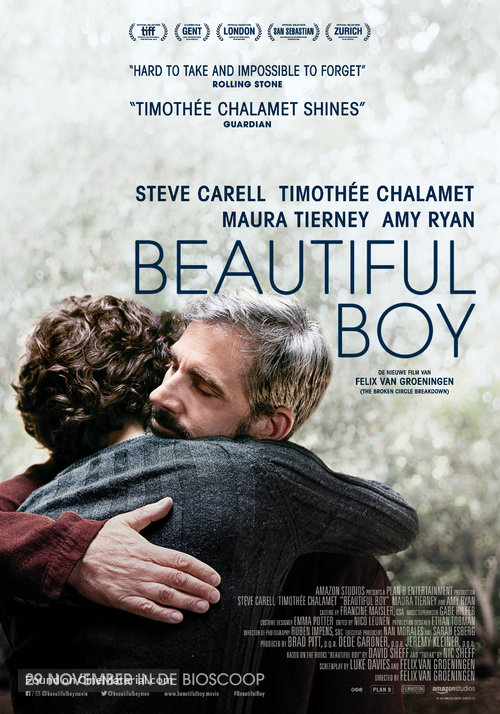
Beautiful Boy

Writers: Felix van Groeningen & Luke Davies

Director: Felix van Groeningen

Since the release of Foxcatcher in 2014 and The Big Short in 2015, Steve Carell has become one of cinema’s most expressive and diverse dramatic actors. The line between comedic and dramatic acting has always been vastly overstated. As Better Call Saul showrunner Peter Gould said when referencing comedy legend Michael McKean’s dramatic turn; ‘if someone can be brilliant at being funny, it’s very easy for them to be brilliant at being dramatic. It’s not always so easy to go the other way.’ While Timothée Chalamet’s drug addicted Nick is Beautiful Boy’s narrative driver, Carell as his father David is the grief-torn, desperate protagonist.

Based on memoirs by journalist David Sheff and his son Nick, Beautiful Boy is centered upon Nick’s battle with addiction and the affect that has on the rest of his family. Nick’s addiction follows a familiar path, from rolled gateway innocence to the needle of no turning back. He recovers and relapses and recovers and relapses. Film’s that centre on something like addiction or a mental illness are defined by how realistic the representation is, and Beautiful Boy does well in that regard. Nick’s addiction is nuanced and based in reality, and the film avoids superficial Hollywood conclusions. Director Felix van Groeningen is not squeamish about showing the more brutal elements of Nick’s addiction, and we are shown multiple, unforgiving shots of Heroin injection. And the worst aspects of addiction are laid bare; stealing the savings of a 6 year old sibling a particularly black-hearted example.

However, this is very much Carell’s film and his anguish at his son’s behavior permeates every frame. Carell excels as a father torn apart by a desperation to understand why Nick uses. This failure to understand is a central theme of Groeningen and Davies’s script; the unknown defines the family members materially affected by drug addiction. You can never really know what causes an addict to destroy themselves unless you’ve caused your own forehead to bleed as well. David feels that a certain set of circumstances he can force Nick to go through will stop him using. But ultimately Nick will keep using until the day he finally stops, any abstinence before that is a very brief sojourn. Carell captures this pain wonderfully; his performance gives the film a heart-breaking rudder.

Chalamet’s performance is not quite as riveting. While Nick’s character has nuance, some of the expository scenes in which is addiction is formed are the film’s least engaging. We see clichéd close-frame shots of Nick’s bleary eyed high as the focus drains from the world around him while dissonant, ‘edgy’ music is overlaid. It’s a shot you’ve seen a million times from Trainspoting to 21 Grams and Beautiful Boy contains a few scenes in which narrative rigor and originality disappear. Whether it’s David finding Nick’s journal or pop songs referencing substance abuse playing over montage sequences of drug-use, there are occasions when the script and Groeningen’s direction become sloppy.

But overall Beautiful Boy is a very effective and moving piece of work. As someone with first-hand experience of living with a drug addict, the film has a commendable verisimilitude. Carell is excellent and Chalamet is very good, and the film also sports an excellent supporting turn from Maura Tierney as Nick’s step-mother Karen. There is a lovely sleight of hand in the third act, where Nick seems to have recovered fully and he gives a triumphant and moving speech to his support group. Only for him to fall far from the rails once more. The film could easily have ended there, leaving the audience draped in the glow of a happy but artificial sunlight. But it doesn’t. Nick relapses again and the film shows how with addiction there are no easy answers and Hallmark endings. Beautiful Boy is ultimately a moving film with some great performances that is overall an honest and heartfelt depiction of addiction, and the often tragic affect it has on those around them.

8/10

The Favourite

Writer: Debora Davis & Tony McNamara

Director: Yorgos Lanthimos

The Favourite has to be weirdest ‘hit’ in several years. Somehow, the re-telling of little-known Queen Anne’s life as a lesbian love-triangle, complete with experimental camera techniques sends people bounding like rabbits to the cinema. The film, by cinema’s new premier existentialist Yorgos Lanthimos, is a bizarre tale of power, both symbolic and real, and the way in which gender interacted within the hallowed halls of the pre-democracy Crown.

The story is ostensibly about the Privy Council members that advised Queen Anne Stewart (Olivia Coleman) during the war with France in the early 18th Century. Sarah Churchwell (Rachel Weisz) is Queen Anne’s closest advisor and secret lover, who holds enormous sway over the Queen and is in some sense, the defacto Queen of England. The arrival of Sarah’s cousin Abigail (Emma Stone) as her maid is the narrative driver, as the two do battle using political subterfuge and sexual fluidity to become the Queen’s titular anointed one. The historical realism should be taken with the biggest pinch of salt you can find.

Coleman’s Queen Anne is a kindly, frail character, whose infinite grief at the loss of 17 children casts her in a perpetual shadow. She is confined by a string of endless physical ailments, most notably gout, to her palace and these illnesses are what allow Sarah to dictate her policies. Coleman is exquisite as Anne, managing to find joyous warmth among the loss central to her character. She’s rightly on course for an Oscar, and will no doubt offer thanks to her mentor Super Hans as she grasps the gold. The Favourite is crammed with great acting; from the brilliant dueling of Weisz and Stone, to the just-the-right-side of panto Nicholas Hoult as opposition leader Harley. Hoult is given perhaps the best line of dialogue you’ll hear this year, describing another character’s romantic attachment as ‘cunt struck.’

Debora Davis and Tony McNamara’s episodic script is frothing, its dialogue propelled by Iannucci -style inventive language and swearing. The world they have created feels both real and alien; the period setting clashing furiously with the upended gender norms and sexual rigidity associated with the time period. This feeling is intensified by the circular framing created by Lanthimos and cinematographer Robbie Ryan, our curved view of the world is just as bizarre as it feels. The film mostly takes place inside the same house, and this twisting visual style allows the same corridors and rooms to be re-invented with every scene.

The men of The Favourite hold much of the practical power; they command the Army and choose battle strategies, they fund the war itself. But they are reduced to desperate sideshows, trying and failing to genuinely affect the political maneuverings of the Sarah and Abigail. Queen Anne’s word may be final but the sentences are scripted by someone else, and those writing the sentences wield the largest axe. But they also have the furthest to fall, as Sarah grimly decrees; ‘there is always a price to pay and I am prepared to pay it.’

These shifting dynamics combine for an exhilarating film, one infused with a piercing subversion in both story and visual terms. Weisz and Stone’s characters never feel like forced creations or like the writers have created them to show how woman can occupy roles most commonly done so by men. They own their lives and the power that comes from them is a by-product.

This sense of anarchy does seem to slip in the last third of the film. As Queen Anne becomes sicker and loses much of her physical body to illness, and as one winner emerges from the political games of Abigail and Sarah, the film becomes more reserved and even mournful. The light drains from the screen and the camera reverts back to traditional framing, Queen Anne’s physical demise seems to straighten the world out. It makes for a weirdly jarring final twenty minutes, in which the more normal the film becomes, the stranger it feels.

The Favourite is a unique film and surreal story told boldly by Lanthimos. It features wonderful acting and fizzing dialogue, and captures the stakes that follow when personal lives and politics become enmeshed. The film’s final third is odd, and as the subversion dims so too does a certain spark. But the excitement that comes from watching such an oddly shaped but brilliantly realized world is rare.

9/10