mid90s

Written and Directed by: Jonah Hill 

Jonah Hill’s first foray into writing and directing is mid90s, a period, coming-of-age piece set in the aforementioned decade and has a surprisingly sweet centre despite many of its characters superficial concerns. The story is centered around teenager Stevie (Sunny Suljic) who decides to become a skater after seeing some ‘cooler’ kids doing it, in an example of instantaneous decision-making only teenagers can manage.  These kids comprise the wise leader Ray, obnoxious Fuckshit, poor Fourth Grade and the groups previous young’un Ruben. The four spend their time skating, drinking, talking about sex and swearing profusely. The dialogue is often funny, and Hill writes the cosmological arrogance of youth well; ‘I’m so much older than you. I drink. I smoke. I fuck bitches.’ 

Mid90s narrative is fairly loose, and we follow the group over several weeks as Stevie becomes initiated in the usual rites of being a teenager, whether using drugs for the first time or his first sexual experience. Hill is a very neutral director and there isn’t, with a couple of exceptions, much stylistic flair. The use of 16:9 framing is humorous and is one of many, many cultural references that pepper the film. There is a particularly gorgeous long-shot, as the group skate down the middle of freeway, the blurred light and focus makes for a woozy, hypnotic frame.  

But the film is lacking any sort of idiosyncrasy. The film treads the familiar plot beats of the coming-of-age film and is not particularly ground-breaking, or even sand-breaking. Katherine Waterston as Stevie’s mother Daubney is criminally underused, and he endless capacity for real humanity shines through in the few scenes she is in.  

As writing and directorial debut, mid90’s offers some proof that Jonah Hill does have a future outside of the acting game. The film’s ending, which involves an interestingly constructed car crash scene, and the way in which the group react with desperate despair at how their actions have landed a 14-year-old in such awful circumstances, suggests a real and intuitive emotional touch.  

7/10  

Alita: Battle Angel

Writers: Robert Rodriguez, Laeta Kalogridis & James Cameron 

Director: Robert Rodriguez 

The writer and director Richard Ayoade once said that ‘actors are the most important thing in a film and there are many examples of actors transcending poor material.’ I personally don’t agree with this and the script is ultimately the most important thing, as that’s the base from which whole film is constructed. Alita: Battle Angel does contain two performances that does offer proof that actors can engage an audience when the script fails to do so.  

Co-written by Avator’s James Cameron and directed Robert Rodriguez, Alita: Battle Angel is the story of an eponymous teenage cyborg struggling to find her identity in a post-apocalyptic Earth. Based on a manga series called Gunnm, the film is set in 2563 in Iron City, 300 years after a war with the United Republic of Mars (URM) ravaged the Earth. It’s all so very standard sci-fi, with flashes of Cameron’s own Terminator to RoboCop to the ever present Metropolis.  

Like all poorly written films, the script is both simple and convoluted. Christoph Waltz’s Dr Ido finds a half-dead cyborg girl in junkyard and rebuilds her, and when she awakes she cannot remember anything about her past life. The film follows Alita as she attempts to find out who she was and who she is, while falling in love with Dr Ido’s assistant Hugo (Keean Johnson). Earth’s main entertainment is a sport called ‘Motorball’ a kind of mix of basketball and Nascar, where people in super-fast robotic suits battle around a track to score baskets. Alita longs to be one of the players but the game is run by Mahershala Ali’s Vector, who is an evil business overlord and set on killing her. He intends to kill Alita because, inevitably, she is last of her kind. She is a long lost URM soldier, the deadliest killing machine Mars ever produced.  

Alita is a bizarre mixture of dystopian sc-fi and teen romance. There a fighting robots and authoritarian governments mixed with scenes in which Alita and Hugo kiss for the first time in the rain. Seriously. The film is that reductive. We are treated to almost beautifully bad dialogue; ‘it’s a harsh world. The strong prey on the weak down here.’ The film hits its plot beats so predictably it could have been written by an A.I. machine that had recently had a stroke. During the films concluding fight sequence, a cyborg bounty hunter called Zaper who has been hunting Alita, has his human face sliced off. He starts jumping around and shouting ‘my face! My face! My beautiful face!’ I can feel the bile in the bottom of my throat beginning to fizz again.  

However, the film is not without merit. Rosa Salazar as Alita does provide the film’s main character with a real humanity. She manages to get the audience to see past her exaggerated, anime eyes and you believe she is a real teenager trying to find her place in the world. Christoph Waltz is excellent as Alita’s essentially adopted father and cyborg surgeon Dr Ido. He brings a world-weariness to the role and the weight of living under conditions of tyranny shines through. The film’s battle and action sequences are pleasantly lucid; Robert Rodriguez’s direction is clear and concise, it is very easy to follow the scene even when there are 10 cyborgs having a scrap at high-speed.  

This a very poor film that contains a couple of good performances and some impressive action sequences that make you forgot some of its more snort-inducing aspects. The film is very much set up to be the first in a series, with Edward Norton popping up at the end as some kind of evil overlord. Whether we will get them or not remains to be seen. However, I’m not sure whether my (less than) beautiful face could take anymore.  

4/10

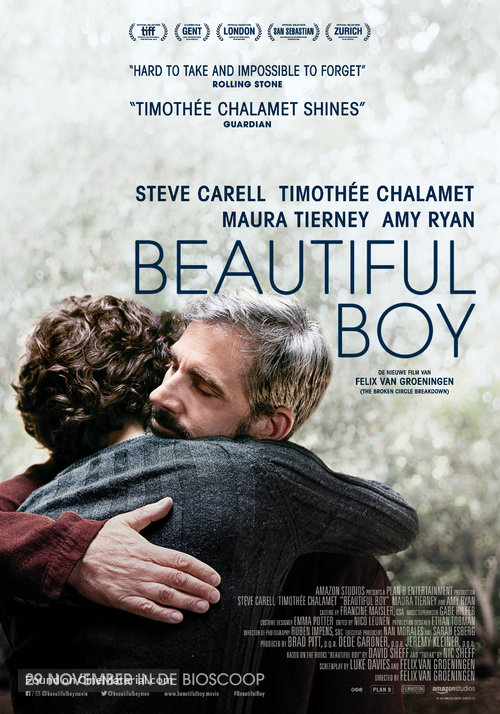
Beautiful Boy

Writers: Felix van Groeningen & Luke Davies

Director: Felix van Groeningen

Since the release of Foxcatcher in 2014 and The Big Short in 2015, Steve Carell has become one of cinema’s most expressive and diverse dramatic actors. The line between comedic and dramatic acting has always been vastly overstated. As Better Call Saul showrunner Peter Gould said when referencing comedy legend Michael McKean’s dramatic turn; ‘if someone can be brilliant at being funny, it’s very easy for them to be brilliant at being dramatic. It’s not always so easy to go the other way.’ While Timothée Chalamet’s drug addicted Nick is Beautiful Boy’s narrative driver, Carell as his father David is the grief-torn, desperate protagonist.

Based on memoirs by journalist David Sheff and his son Nick, Beautiful Boy is centered upon Nick’s battle with addiction and the affect that has on the rest of his family. Nick’s addiction follows a familiar path, from rolled gateway innocence to the needle of no turning back. He recovers and relapses and recovers and relapses. Film’s that centre on something like addiction or a mental illness are defined by how realistic the representation is, and Beautiful Boy does well in that regard. Nick’s addiction is nuanced and based in reality, and the film avoids superficial Hollywood conclusions. Director Felix van Groeningen is not squeamish about showing the more brutal elements of Nick’s addiction, and we are shown multiple, unforgiving shots of Heroin injection. And the worst aspects of addiction are laid bare; stealing the savings of a 6 year old sibling a particularly black-hearted example.

However, this is very much Carell’s film and his anguish at his son’s behavior permeates every frame. Carell excels as a father torn apart by a desperation to understand why Nick uses. This failure to understand is a central theme of Groeningen and Davies’s script; the unknown defines the family members materially affected by drug addiction. You can never really know what causes an addict to destroy themselves unless you’ve caused your own forehead to bleed as well. David feels that a certain set of circumstances he can force Nick to go through will stop him using. But ultimately Nick will keep using until the day he finally stops, any abstinence before that is a very brief sojourn. Carell captures this pain wonderfully; his performance gives the film a heart-breaking rudder.

Chalamet’s performance is not quite as riveting. While Nick’s character has nuance, some of the expository scenes in which is addiction is formed are the film’s least engaging. We see clichéd close-frame shots of Nick’s bleary eyed high as the focus drains from the world around him while dissonant, ‘edgy’ music is overlaid. It’s a shot you’ve seen a million times from Trainspoting to 21 Grams and Beautiful Boy contains a few scenes in which narrative rigor and originality disappear. Whether it’s David finding Nick’s journal or pop songs referencing substance abuse playing over montage sequences of drug-use, there are occasions when the script and Groeningen’s direction become sloppy.

But overall Beautiful Boy is a very effective and moving piece of work. As someone with first-hand experience of living with a drug addict, the film has a commendable verisimilitude. Carell is excellent and Chalamet is very good, and the film also sports an excellent supporting turn from Maura Tierney as Nick’s step-mother Karen. There is a lovely sleight of hand in the third act, where Nick seems to have recovered fully and he gives a triumphant and moving speech to his support group. Only for him to fall far from the rails once more. The film could easily have ended there, leaving the audience draped in the glow of a happy but artificial sunlight. But it doesn’t. Nick relapses again and the film shows how with addiction there are no easy answers and Hallmark endings. Beautiful Boy is ultimately a moving film with some great performances that is overall an honest and heartfelt depiction of addiction, and the often tragic affect it has on those around them.

8/10

The Favourite

Writer: Debora Davis & Tony McNamara

Director: Yorgos Lanthimos

The Favourite has to be weirdest ‘hit’ in several years. Somehow, the re-telling of little-known Queen Anne’s life as a lesbian love-triangle, complete with experimental camera techniques sends people bounding like rabbits to the cinema. The film, by cinema’s new premier existentialist Yorgos Lanthimos, is a bizarre tale of power, both symbolic and real, and the way in which gender interacted within the hallowed halls of the pre-democracy Crown.

The story is ostensibly about the Privy Council members that advised Queen Anne Stewart (Olivia Coleman) during the war with France in the early 18th Century. Sarah Churchwell (Rachel Weisz) is Queen Anne’s closest advisor and secret lover, who holds enormous sway over the Queen and is in some sense, the defacto Queen of England. The arrival of Sarah’s cousin Abigail (Emma Stone) as her maid is the narrative driver, as the two do battle using political subterfuge and sexual fluidity to become the Queen’s titular anointed one. The historical realism should be taken with the biggest pinch of salt you can find.

Coleman’s Queen Anne is a kindly, frail character, whose infinite grief at the loss of 17 children casts her in a perpetual shadow. She is confined by a string of endless physical ailments, most notably gout, to her palace and these illnesses are what allow Sarah to dictate her policies. Coleman is exquisite as Anne, managing to find joyous warmth among the loss central to her character. She’s rightly on course for an Oscar, and will no doubt offer thanks to her mentor Super Hans as she grasps the gold. The Favourite is crammed with great acting; from the brilliant dueling of Weisz and Stone, to the just-the-right-side of panto Nicholas Hoult as opposition leader Harley. Hoult is given perhaps the best line of dialogue you’ll hear this year, describing another character’s romantic attachment as ‘cunt struck.’

Debora Davis and Tony McNamara’s episodic script is frothing, its dialogue propelled by Iannucci -style inventive language and swearing. The world they have created feels both real and alien; the period setting clashing furiously with the upended gender norms and sexual rigidity associated with the time period. This feeling is intensified by the circular framing created by Lanthimos and cinematographer Robbie Ryan, our curved view of the world is just as bizarre as it feels. The film mostly takes place inside the same house, and this twisting visual style allows the same corridors and rooms to be re-invented with every scene.

The men of The Favourite hold much of the practical power; they command the Army and choose battle strategies, they fund the war itself. But they are reduced to desperate sideshows, trying and failing to genuinely affect the political maneuverings of the Sarah and Abigail. Queen Anne’s word may be final but the sentences are scripted by someone else, and those writing the sentences wield the largest axe. But they also have the furthest to fall, as Sarah grimly decrees; ‘there is always a price to pay and I am prepared to pay it.’

These shifting dynamics combine for an exhilarating film, one infused with a piercing subversion in both story and visual terms. Weisz and Stone’s characters never feel like forced creations or like the writers have created them to show how woman can occupy roles most commonly done so by men. They own their lives and the power that comes from them is a by-product.

This sense of anarchy does seem to slip in the last third of the film. As Queen Anne becomes sicker and loses much of her physical body to illness, and as one winner emerges from the political games of Abigail and Sarah, the film becomes more reserved and even mournful. The light drains from the screen and the camera reverts back to traditional framing, Queen Anne’s physical demise seems to straighten the world out. It makes for a weirdly jarring final twenty minutes, in which the more normal the film becomes, the stranger it feels.

The Favourite is a unique film and surreal story told boldly by Lanthimos. It features wonderful acting and fizzing dialogue, and captures the stakes that follow when personal lives and politics become enmeshed. The film’s final third is odd, and as the subversion dims so too does a certain spark. But the excitement that comes from watching such an oddly shaped but brilliantly realized world is rare.

9/10

The Hate U Give

Writer: Audrey Wells

Director: George Tillman Jr.

Possibly the most important book written in the 21st century thus far is Ibram X. Kendi’s colossal Stamped from the Beginning, a history of racist ideas in America. Over 600 brutal and unrelenting pages, Kendi carefully demonstrates how the systemic racism of modern American society was formed. Kendi goes into detail about the phenomenon of black people literally making themselves whiter, by bleaching their skin or straightening their hair. This schizophrenic and tragic behaviour permeates throughout The Hate U Give and in particular the protagonist Starr, who finds herself split between worlds inhabited by either white people or black.

The Hate U Give is adapted from a 2017 novel by Angie Thomas and is directed by George Tillman Jr., who also helmed Biggie biopic, Notorious. The film follows a few weeks in the life of Starr Carter, played by Amandla Stenberg in a career-making performance, after she witnesses her best friend Khalil murdered by a police officer. The opening scene is devastating in its intimate brutality. It sees Starr’s father, the imperious Russell Hornsby as Maverick Carter, giving his three children the ‘talk.’ This is not the ‘birds and the bees’ talk you might expect, but rather he goes into detail about how to react when interacting with a police officer, in order minimize the risk of harm. His children are ten, nine and one. It’s a damning indictment of any society that a parent should feel this necessary. And this idea is a continuous theme of the film, that a black person’s interaction with the state is different than that of other races. An unexpected knock at the door is greeted with fear rather than curiosity.  

Starr and her older brother Seven attend a private, predominately white school, away from the family’s community in Garden Heights. Here Starr is forced to avoid acting too ‘black’ in order to escape unwanted attention, as she succinctly puts it; ‘when white kids use slang, it’s cool. When black kids do it, it’s ghetto.’ Following the shooting of friend, Starr becomes the key witness in a grand jury case and is faced with fallout from the exposure of TV interview, after bravely calling out the role of drug kingpin King Lord in Khalil’s death. Tillman Jr.’s direction is very muted, he allows Audrey Wells’ script to exist without any whiff of flourish, which allows the never-ending brutality in which the state treats Starr’s family to be viewed unvarnished.

It is not possible to overstate how extraordinary Stenberg’s performance is. The emotional honesty, the anger, the desire for justice; they all exist within the confines of her craft. The year may only be five weeks old, but we quite possibly have already seen the leading performance of the year.

The Hate U Give is about how a family responds to a tragedy, and how this response becomes enmeshed with that of the wider community. After the inevitable failing of the police shooter to be held accountable, the Garden Heights community erupts into an understandably rage-fuelled protest. Wells’ script outlines how depressingly predictable the response society has to such tragedy is. How protests and riots and speeches and biased news coverage never serve to make any discernible difference. Both sides are seemingly trapped in an endless conveyor belt, in which actions have already been decided long ago.

This is a powerful piece of work, one which induces rage and sadness in equal measure. The film is an unashamed, unequivocal call to arms. The story may centre around Starr and her family but the film’s ultimate aim is to energise people into action. And Tillman Jr. and Wells make clear what real engagement is, actively helping the black community in their struggle and not the consumerist protests held at Starr’s school. The film is not without fault, there is some hideously clunky expositional dialogue and an over-use of voiceover. But as a film that documents black experience in unceasing, often traumatic but ultimately hopeful fashion, it is an astounding achievement.

9/10

The Graduate

Writers: Calder Willingham & Buck Henry 

Director: Mike Nichols 

I first saw The Graduate when I was 21 and before sitting down to watch it, I had no idea what is going to be about. I knew the name, it’s difficult not too given its exultant place within the canon, and I knew Dustin Hoffman starred. It never occurred to me that it was literally about a college graduate. I thought it was going to be a gangster film. No wonder I never get paid for writing these reviews.  

Since its release in 1967 The Graduate has certainly managed to acquire ‘classic’ status, insomuch as when it appears in TV listings the word ‘classic’ will appear in the description. The film follows a summer in the life of Hoffman’s Benjamin Braddock after he GRADUATES (such a fool I am) from college and begins an affair with Anne Bancroft’s Mrs. Robinson. This affair continues for a few months before Ben ends up falling in love with Mrs. Robinson’s daughter Elaine. Bancroft and Hoffman are both excellent in their roles; Hoffman excels as the odd, insular but sweet Benjamin, and Bancroft brings a magisterial sadness to the lonely Mrs. Robinson.  

The film’s opening sequence is staggering. A glorious tracking shot as Benjamin stands on an airport walkway, set against the wonderfully drab grey background. Fifty-odd years later this scene is still raising hairs for its simplistic beauty, it is a shot that completely defines Benjamin as a character. He is very much an insular figure, as we track him, he barely seems to register that other humans exist, he resides only inside his own head. It’s a work of directorial genius by Mike Nichols. And of course, over the top plays Simon & Garfunkel’s’ ‘The Sound of Silence’, one of basically three recurring songs over the film. The song was not written for the film, it was not based on Simon seeing any footage, but the song and film are now inexorably linked. When you hear that gorgeous guitar line, you can only see Hoffman’s face.  

The Graduate handles the relationship between Mrs. Robinson and Benjamin sensitively, initially at least. We never really learn anything about either character across whole film, we never even learn what subject Benjamin graduates from. We know that Mrs. Robinson is lonely, trapped in a loveless, shotgun marriage and drinking excessively. But we never learn anything about their past, we only learn what they say in the moments between the sex. It is difficult to describe their relationship as anything other than oedipal. Willingham and Henry’s script during the beginning of their relationship is very funny, and Hoffman has great comic timing as the ever-awkward Benjamin. In the film’s opening two acts, Mrs. Robinson controls the relationship, dictating how they meet, when they meet and dominating their sexual activity. As their relationship evolves, Benjamin does become more confident, but it is not until the arrival of Mrs. Robinson’s daughter Elaine that Benjamin rejects her authority.  

Unfortunately, the arrival of Elaine (Katharine Ross) in the third act brings about the total collapse of the film. After one date, which goes reasonably well but not great, Benjamin falls head over heels in love with Elaine. After he reveals that he has been having an affair with her mother, she is inevitably mortified and returns to college in Boston. From here, Benjamin morphs from an awkward, introverted but good-natured oddball to an unbridled stalker. His insular nature turns to terrifyingly obsessional. He follows Elaine to Boston; stalks her and decides he is going to marry her. This is all presented by director Nichols as the harmless, intense romance of a man in love. But there is no getting away from the fact that his actions are well beyond the normal romantic obsession any of us may feel, it feels criminal the actions Benjamin undertakes. And of it course it eventually works, as it always does in films from this period of history, and unfortunately many in the modern day.  

There are certainly arguments to be made that the relationship that Benjamin has with Mrs. Robinson engenders his later behavior towards Elaine. She enters into a relationship with a young, emotionally immature male, his first sexual relationship, and he is not ready for it. His first romantic relationship is based around subterfuge and deceit, and it is Mrs. Robinson who teaches him how to do it. Her part in Elaine’s story is equally complicit and her decision to allow Elaine to get married in similar circumstances as she did, with the same potential for unhappiness, speaks volumes about the society in which they reside.  

However, Benjamin’s actions are his own and Willingham and Bucky’s script is much too lenient in glossing over aggressive and dangerous behaviour. The Graduate contains many moments of wonder, exquisite direction and glorious music. But the film’s collapse in the final third is a catastrophe, Benjamin’s behaviour is beneath contemptible and Nichols & co. present it not only as acceptable, but as the perfect way to a woman’s heart. 

6/10

Mary Poppins Returns

Writer: David Magee (Screenplay) David Magee, Rob Marshall & John DeLuca (Story)

Director: Rob Marshall

As a child and teenager I detested musicals. They could reduce me to a scything rage, like Tommy Robinson being forced to have a pint with a non-binary vegan. As a child I just found them utterly bizarre; why were these people always singing and why did they never talk about it afterwards? I was very much your typical sneering, ‘indie’ teenager, which meant I had a phobic reaction to a single whiff of sentimentality. And if there is one thing that seems to define musicals; it’s a sometimes wonderful, often mawkish sentiment.

Sadly, Mary Poppins Returns has not cured me of my ‘Cue Song’ aversion. The sequel to Disney’s 1964 perennial TV classic Mary Poppins takes place roughly 25 years after the original. Jane (Emily Mortimer) and Michael (Ben Wishaw) are adults living in 1930’s London, Michael still residing in the original house with his three children, Annabel, John and Georgie. Simply put, the plot of the film is Michael is five days away from having his house repossessed by Colin Firth’s villain banker William Wilkins. The Banks family is inevitably dysfunctional and down on their luck, mostly due to the death of Wishaw’s wife and the children’s Mother. This leads, by the way of a magic kite, to the return of Emily Blunt’s Mary Poppins.

Blunt is in no sense playing Julie Andrews playing Mary Poppins, which is the only way taking on such an iconic character can work. And she does make it work, she charms as the brisk but deeply caring Poppins, and given her accent, was presumably raised by BBC schedule announcers. This is a very RP film; it’s very much a classic take on England, all ‘sir’, ‘ma’am’, and ‘veddy good’. But Blunt shines in a role that is difficult to pull off, even without the need to sidestep Andrew’s shadow. Like all great children’s heroes, Blunt’s Poppins radiates with hope. She is magical and leads the children on glorious adventures, but she gives them the space to solve their own problems.

Aside from Julie Walter’s decent comic turn as housemaid Ellen, Hamilton creates Lin-Manuel Miranda is the only other major character not sounding like Radio 4 turned sentient. And, unfortunately, he is by far the most intensely annoying character in the film. His accent is appalling, a hacky ol’ chimney sweep cockney that itches the skin from the outset. He opens the show with the worst song in the film, ‘(Underneath the) Lovely London Sky’, which sounds like Ray Winstone ‘Live at the Palladium’. He already knows that Mary Poppins is magical, so he spends the whole film in an almost bored relaxation, no matter how fantastical the adventures get. On the whole though, the acting in Mary Poppins Returns is pretty good. Emily Mortimer as worker’s rights activist Jane Banks is excellent, and Ben Wishaw is great in a very much to type casting as a grieving, emotionally damaged man. Kobna Holdbrook-Smith is genuinely hilarious as a little too nice lawyer, Mr Fyre. And Colin Firth is, well, Colin Firth.

Director Rob Marshall has a showbiz but fairly neutral style and manages to create some excellent set-pieces, especially the ones that blend animation and live-action. The scene in which the children, Poppins and Jack go inside an illustrated bowl has a lovely, hand-drawn Saturday cartoon feel to the it. This sequence in particular feels both comfortingly classic and cutting-edge, which is surely what Marshall was aiming for. John Myhre’s production design is excellent; the streets of 30’s London are vivid and lush, with very bold colours. The city feels like a confection tin come to life, with the right amount of sheen and sweetness.

However, the film is several metres short of greatness. The songs, written by Marc Shaiman and Scott Wittman, are fairly innocuous and have none of the lasting earworm magic of the original. There is also a huge number of them, surely one every ten minutes, which feels like too much. Dave Magee’s script clips along as it should, hitting every emotional beat you imagine from the film’s starting off point of Jane and Michael searching desperately for a certificate that proves they own some of the bank that is demanding loan repayment. There is no getting away from the film’s saccharine nature and the chance to explore some interesting ideas about how the Great Depression affected the lives of the middle-class in London are lost beneath age-old, superficial resolutions.

It cannot be argued though that the film is not a success. I mean it literally is in terms of box-office but more in the sense that it’s an immensely difficult thing to pull off, make a sequel to arguably the most popular family film of all time. Nobody hates it, most people are actually filled with joy by it, and given they could easily have cried ‘HERESEY’, that counts as a huge win. However, whether Mary Poppins Returns will last the ages like the original remains to be seen. I no longer view musicals with teenage enmity; some of them are excellent, but this Poppins is too close to the centre to garner my real enthusiasm.

6/10

Mary Queen of Scots

Writer: Beau Willimon 

Director: Josie Rourke 

Despite spending 18 out of every 20 seconds at school studying the Tudors, my knowledge of Mary Stuart was limited before viewing Josie Rourke’s masterful directorial debut, Mary Queen of Scots. I knew the basics; she was Scottish, had red hair and had an altercation with a guillotine which didn’t go so well. But apart from that, the relationship between her and Elizabeth I was lacking from our never-ending Tudor study. Perhaps the reason, as this film shows, the relationship was too complex for the simple narrativized history the UK government constantly peddles.  

The film is centered upon Mary’s, the wonderful Saoirse Ronan, return to Scotland after the death of her husband in France. She returns to the throne of Scotland, which threatens the reign and ultimate succession of Margot Robbie’s Elizabeth. Mary claims the right to succeed Elizabeth on the English throne and naturally Elizabeth disagrees. The film follows the battle between the two courts as they use politics, the military and progeny to try and dominate the other.  

Mary Queen of Scots is the story of two women trapped within a sea of largely deplorable men. These are not uninteresting men, David Tennant as the puritan priest John Knox has surely put in the supporting turn of the year, unrecognizable as a hate-spewing monster.  Gender dynamics and power are at the centre of Beau Willimon’s script, and how Mary and Elizabeth define themselves in relation to their gender. Mary is far more comfortable than Elizabeth in owning her gender in relation to the rampant misogyny they both face on a second-by-second basis. Elizabeth at one-point declares; ‘I am more man than woman now. The crown has made me so.’ Mary and Elizabeth are the de facto rulers of England and Scotland, their word is law and they can declare an execution at the snap of their jewelled fingers. But the courtiers that surround them, the advisors and the Earls, they feel as if the power rests with them. And, more importantly, they detest the fact a human with a vagina is the one giving out orders. When Lord Randolph and the Earl of Moray, the two top advisors to each queen, are discussing the battle between the two Crowns, Moray comments; ‘How did it come to this? Wise men beholden to the whims of women.’ 

There are many startling aspects of this film; Saoirse Ronan and Margot Robbie’s performances are both wonderful in distinct ways. Ronan plays Mary with an underlying rage; the anger at having to battle with her cousin and the never-ending effort to quell the ceaseless coups against her. While Robbie’s Elizabeth is a resigned, almost heartbroken figure. She knows Mary has rights to the English throne, but the machinations of power leave her no choice but to pursue her death.  

One overlooked aspect thus far in many reviews is the fighting sequence that takes place between fighters loyal to Mary and others to Knox and Moray. Pre-artillery fighting sequences are a common part of cinema and TV but often come within a fantasy context, think Tolkien or Game of Thrones. The fighters in Mary Queen of Scots seem utterly normal, devoid of any notion of super-human fighting skills that fantasy characters often come with. To see these villagers, peasants, running at each other with no defenses and no medicine in the event of inevitable injury, is gut-wrenching. It is a relatively short sequence, less than five minutes, and yet it feels far more emotional and full of jeopardy than an hour of fighting in a fantasy realm.  

Director Josie Rourke and cinematographer John Mathieson use clever colour codes to distinguish between Mary and Elizabeth, England and Scotland. Elizabeth’s English court is all wood and gorgeous natural light, whereas Mary’s Scotland is an equally lavish but bare castle, lit by roaring fires. Mathieson uses light to create wonderfully distinct looks for each country, without sinking to clichéd dualities. Red is another colour that appears throughout the film, whether Mary’s period or the dress she is ultimately executed in. Rouke and Mathieson use it to demonstrate the dual historical perception of Mary; she is not remembered as an incredibly intelligent, bi-lingual ruler. Instead, she is remembered as a woman who gave birth and had sex with someone she shouldn’t (which she didn’t).  

This is a striking debut by Josie Rourke, and she transitions from the stage to screen with encouraging deftness. Her decision to employ colour-blind casting to a period drama, a long-time feature of theatre, gives a modern, cosmopolitan feel to the characters. And the beautiful wide-shots of the Scottish landscape show how she can use the full scope of the medium. The scene in which Mary and Elizabeth finally meet is perhaps the single example of Rourke’s stage sensibility failing to land. They meet in a house filled with sheets hanging from the ceiling, ostensibly to stop them seeing each other but the effect is more annoyance than mystery. You end up things; ‘just tear down the sheets! And is something that would have perhaps been striking on stage but looks silly on screen. Either way, Rourke, along with fantastic central performances from Ronan and Robbie, have created a sensitive, realistic drama about a much-misunderstood figure. 

9/10 

Wildlife

Written By: Paul Danno & Zoe Kazan

Directed By: Paul Danno

Paul Danno is perhaps best known for playing Brian Wilson in 2014’s Love and Mercy, or for his brilliant comic turn as a member of the Animal Liberation Front in Jon Ronson’s OkjaWildlife is his first directorial feature and he takes to the task with a delicate touch. Wildlife, based on a novel by Richard Ford, is the story of a marriage and family in disintegration, set amongst a wonderfully realised late 50’s time period.

The story is told from the perspective of 14 year-old Joe, the subtle but interesting Ed Oxenbould, as his Mother and Father’s relationship crumples. Newly moved to Montana, Joe and his parents Jerry and Jean are presented in the film’s opening sequence as the textbook Nuclear family of mid-century America. We see shots of Jake Gyllenhaal’s Jerry working hard at his grounds man job, while Jean, bought to life by the staggering Carey Mulligan, is an apron-clad hero of the family home.

This tranquillity is brought down by Jerry being fired at the Golf club he works and then, more importantly, turning down the chance to re-join the company when they offer him his job back. This sends Jerry spiralling into a depressed slump, which he uses an excuse to drink excessively; but crucially it allows Jean to re-enter the workplace, having left her previous job as a teacher to become a full-time housewife. From the outset, Danno and fellow screenwriter and actor Zoe Kazan, seek to show how Jeanette is pummelled by the gender boundaries of 50’s America. Mulligan plays the opening act with a furious resignation, she might love her son but she detests the fact her life is defined by groceries and cleaning. Mulligan is sublime in the role as Jean, bringing a ferocious intelligence mixed with an often devastating emotional veracity.

Jerry decides that he wants to leave Joe and Jean to go and help with the fight against a wildfire that is ravaging a forest in Montana. Jerry’s life seems defined by failure; he bounces from one dead-end job to another and is locked into the proscribed bread-winner role. He is much more emotional than his society allows him to be, saying to his son as he departs and kisses him, ‘men are allowed to love each other too.’

This decision leaves Joe and Jean alone in the house together and it exposes the bizarre intimacy at the heart of their relationship. Jean treats Joe as a mixture of best friend, therapist and son. She tells him about her sex life (or lack thereof), her deepening existential angst at the state of her life and the insecurities that come with that. Joe views all this with a bemused, often weirded out confusion. Danno has clearly instructed Oxenbould to play Joe to be as reserved as possible, his face is often impassive and his dialogue trimmed down to ‘Yes, sir,’ ‘No, Ma’am’ or ‘Is everything going to be okay?’ This allows the film to focus on Jean and how she responds to Jerry’s decision to leave the family for a low-paid, extremely dangerous job. The gap that Jerry leaves gives Jean a freedom she hasn’t really had since she gave birth to Joe. Gone are the aprons and the drab, plain dresses and she starts experimenting with colours and styles. Her anger at Jerry is clear but at some level she is glad when he leaves, as it finally allows the implicit oppression of her life to start cracking. This freedom brings with it a brutal new reality for Joe, as he witnesses first-hand the extent to which his mother will push this new life.

This is a very still film. The camera is often static, barely moving for the length of a scene. Often, a character will exit the frame and continue talking off-screen and the camera will be unrelenting in its motionless. The film is almost the anti-Birdman; it places the actors in front of the screen and lets them go. It also very small in terms of locations, existing mainly in the family home and the various work places which create a localised, intimate feel. The only time we see a true wide-shot is when Jean and Joe take a drive to see the wildfires Joe has left them to try to fight. The film itself has a wonderfully luxurious feel thanks to the work of cinematographer Diego Garcia and production designer Akin McKenzie. Danno and Kazan’s script is tight and held together by an admirable realism in terms of character and setting. Although, the presentation of time within the film is far from perfect and there are no indicators of over how many days/weeks/months the narrative lasts.

During a particularly ruthless parental argument, Jerry asks Joe his opinion and Jean spits, ‘Don’t ask him. He’s too young to know what is and what isn’t.’ This is one of the few times in the film in which Jean is dead wrong. Danno and Kazan use the small story of a family in crisis as a way of showing the damage societies defined by gender has on individuals. In a society in which emotions are regulated and gender roles codified, it is the adults who are truly unaware of how to feel or act.

8.5/10

First Man

Written By: Josh Singer 

Directed By: Damien Chazelle  

I was at a screening in 2015 and an advert for La La Land came on. You know how it goes; girl meets boy, there’s a dance and a song, they seem sexually compatible and love blooms. I turned to my friend and said; ‘Well, that looks apocalyptically shit.’ And yet it turns out to be the biggest commercial and critical hit of the year. What a funny ol’ world.  

Damien Chazelle’s next feature is a world apart from La La Land, both figuratively and literally. While La La Land was all sheen and glitter and choruses, First Man is a brooding film with a surprisingly dark colour palette.  

First Man is the story of Neil Armstrong, the 1969 moon landings and America’s ascent to the summit of Cold War space race. At least, that’s superficially what the film’s narrative is centred upon. In actuality, First Man is concerned with the inner life of Armstrong and his struggle to recover from the grief of losing his daughter to a childhood illness. Armstrong, played wonderfully by Ryan Gosling, is a character defined by death. The death of his daughter, the death of his fellow pilots and the death of his fellow astronauts.  

Naturally, this film contains many great sequences of space flight and the inevitable money shot of Armstrong on the Moon. But the most alien aspect of the film is Armstrong’s inability to express any public or private emotion. His hyper-masculine emotional repression makes the 1960’s feel like Jupiter, let alone the Moon. He cannot discuss his daughter’s death or the death of the many friend’s that die during the lead up to 1969. The male default of internalising all pain or grief, which obviously still exists, is laid bare by Chazelle and Gosling. It is a smart decision by screenwriter Josh Singer to focus on the emotional landscape of Armstrong rather than the boorish politics that informed the Moon landings. Armstrong emotional life seems utterly bizarre and pre-historic, it’s like watching a Neanderthal trying to make a Spotify playlist. We all know men who are still like this, it is often a central reason for the rate of depression related illness in males. But Armstrong’s complete rejection of any emotional vulnerability makes the 20th century seem much further away than it actually is. The opening sequence of the film is Armstrong completing a small spaceflight and leaving the Earth’s atmosphere, briefly. He is of course wearing a spacesuit, with the customary helmet – a costume he wears throughout the film. The serves as a perfect metaphor for Armstrong’s emotional life; a person trapped behind glass, distant from the rest of the world. 

Armstrong stands in stark contrast to his wife Janet, played by Claire Foy, who is so good I didn’t realise it was her until the credits rolled. She is expressive, open and honest; and while Neil pours his entire life into NASA, Janet pours her’s into her children. Despite occupying a fairly stock female role of a woman waiting in fear at home while her husband does something dangerous, Foy brings so much life and warmth to the character, she rises above it. The standout scene of the film is not the multiple space sequences, but the scene in which Janet confronts Neil about his lack of emotions and refusal to talk to his sons before the Moon mission. It is wonderful acting from both Foy and Gosling, with gripping writing and direction.  

This is by no means a perfect film, I would struggle to describe it as a great one. For all it’s good qualities; Gosling and Foy, Justin Hurwitz’s score, the beautiful silent shot when they finally land on the Moon and Singer and Chazelle’s ability to create jeopardy in a historical story where there isn’t much, there is something lacking. The film is very underwhelming, so muted it sometimes feels like it barely exists. It just kind of rolls along, scene to scene and then it ends. It is a sombre film lacking a spark that really brings the world to life. There is also some poor construction in the scenes in which Armstrong is in space and something goes wrong with the ship he is flying. It is hard to understand what has gone wrong and how they fix it, and these sequences are undermined by poor direction and frenetic editing. There is much to be commended in Chazelle’s decision to move away from the Hollywood gleam of La La Land towards something more thoughtful and real. But you can’t shake the feeling as you watch First Man, that this is Sunday night filler rather than Saturday night prime.  

6.5/10